
 Français
 English
 Deutsch
Why raise my own rootstocks?
That is the first question to ask.
Beyond the satisfaction of growing your plants from the seed up, the main benefit for me is the quality of what you end up with. When you buy a rootstock or a grafted plant, you have no idea what the roots look like. In most cases there is no problem — it depends on how careful the grower is — but I examine the root system of every plant of mine that dies, and I often find a root defect.
The second benefit is financial, if you want to produce a decent quantity. That said, once you add up seed, cell trays, growing medium, water, fertiliser, time and selection, I am not convinced you can compete with the Spanish producers — certainly not for a handful of plants.
Which rootstock to choose?
Once you have decided to raise your own, you have to choose the variety.
That choice depends on your soil and your climate. The certified seed page sets out the characteristics of the main rootstocks used in our latitudes:
- Citrange C35
- Citrumelo 4475
- Poncirus trifoliata
- Volkameriana
Forner Alcaide 5 (FA5) is not available as seed — it is a protected variety.
Choosing a rootstock is always a compromise between hardiness, suitability to your soil, disease resistance, and compatibility with the variety you intend to graft onto it. Sadly there is no universal, perfect rootstock.
In every case you want two things from a rootstock:
- A straight stem, for looks — a matter of taste
- A good root system, suited to your soil
For straightness, all you need is reasonably level ground, a dense enough sowing, or a cane. Cell trays have the advantage of unmatched plant density, so the rootstocks guide one another.
For the root system, several factors improve its development and quality:
- the depth of the pot or cell tray
- the growing medium
The advantage of a cell tray is the number of plants per square metre; the drawback is that the medium dries out faster than in a pot holding twice as much.
Pot or tray, the container should be as deep as possible in order to preserve the taproot:
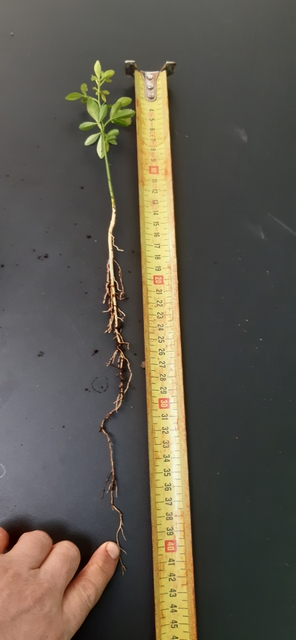
By way of example, by the time the seedling is barely showing, the taproot is already 4 to 5 cm long:
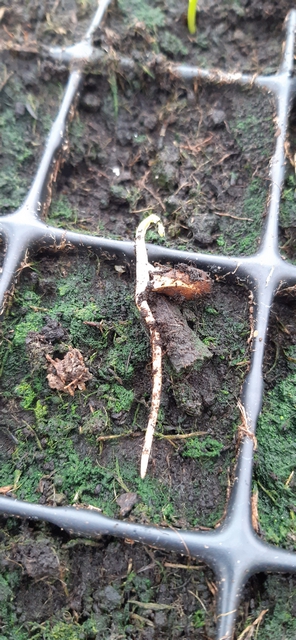
Have you ever noticed that self-sown cherry seedlings need no watering? Unlike the cherry tree you bought, which you have to water every fortnight for the first two or three years…
The second important factor is the growing medium. After several years of trials I see a wide gap between cheap composts — to be avoided, obviously — mid-range ones and professional grades.
The quality and fineness of the medium limit J-rooting.
My best results so far have been with Klasmann H Pot Grond.
This year I am comparing three composts:
- Klasmann H Pot Grond
- Klasmann Traysubstrat
- Jiffy
Results in January 2024.
Where to get seed
Once the variety is chosen, you need good seed. Either you buy certified seed, or you harvest fruit from rootstock trees and extract the seed yourself.
Certified seed should be kept in the fridge, and for as short a time as possible before sowing.
Seed from your own rootstocks should be left inside the fruit until the last moment. The fruit can be heeled into sand for storage.
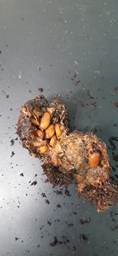
Do not leave it too late, though, or the seed germinates inside the fruit — from mid-January here in the case of poncirus.
With uncertified seed you must be rigorous about selection, to weed out off-type plants resulting from chance crosses.
When to sow
The ideal sowing window runs from January to April, depending on region and weather.
I sow from mid-January under glass.
How to sow
As we have seen, the container should be as deep as possible; by my criteria the best compromise is a cell tray or a 7×7×18 pot. So begin by filling the trays and firming the medium — three passes, particularly along the edges, which are always less compacted:
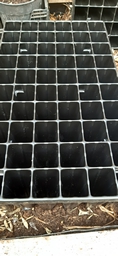
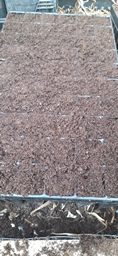
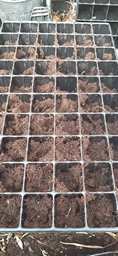
Form the holes by hand or with another tray:
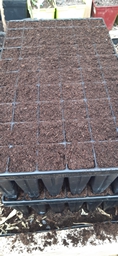
Then place the seed in each little hole:
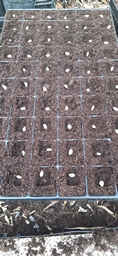
Top up with medium and firm it well so that the seed does not shift when you water, then add an identification label — a number or the name:
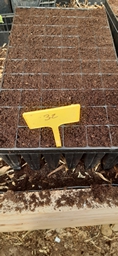
Water thoroughly and that is it.
One word of warning: once the trays are filled, carry them across their width — as in the photograph above — or the tray will bend or snap in the middle.
Now you wait. Depending on the weather, germination can take several months.
In the meantime, simply keep an eye on the moisture of the medium and on rodents, which dig the seed up and eat it. Slugs and snails also love to shelter under the trays:
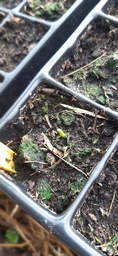
For my part I sow from mid-January under glass on a hotbed, and the first ones come through in March:
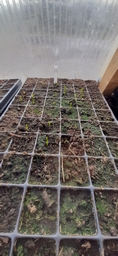
Then it moves fast — under a fortnight:
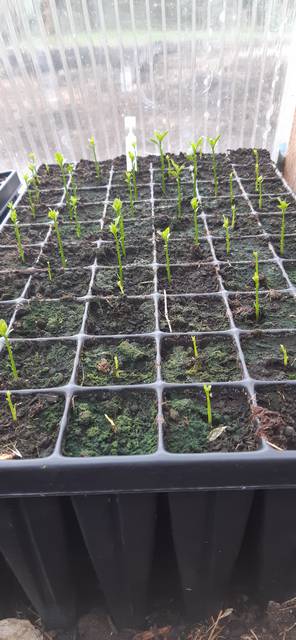
Through the first year the trays need generous watering and damping down.
After a year in cultivation the plants have grown well:
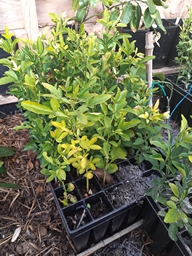
You can then start selecting. See the guide to growing your own rootstocks.